
The Home Office Furniture Setup That Actually Improves Your Productivity
While setting up a home office, you have to be cautious about what kind of furniture you are using. You will be spending a lot of time there, and it is important to get furniture that will help improve your productivity while keeping you comfortable.
Key Takeaways
- Precision Architectural Posture: High-performance remote work requires a workspace designed for your exact proportions. Custom-milled desk heights and uninhibited knee-room voids optimise your seating alignment and eliminate physical fatigue.
- Invisible Infrastructure Controls: Cluttered cords degrade focus. Incorporating CNC-routed cable tracks, flush desktop grommets, and hidden technology enclosures directly into your cabinetry removes visual stress.
Reclaiming WFH Spatial Assets: Floor-to-ceiling built-in cabinetry and custom wall-to-wall alcove desking maximise the room’s volume, turning dead corners into high-capacity storage that boosts your home’s value.
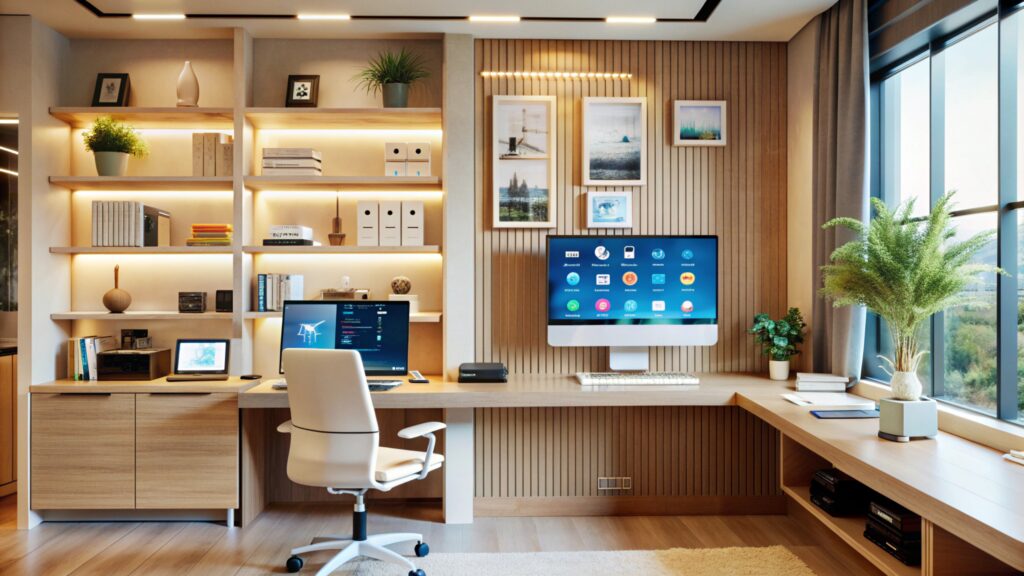
What Home Office Furniture Can Improve Productivity?
The aesthetics of custom furniture have a visual appeal and fit your home’s aesthetics perfectly, but more importantly, they are designed to improve how efficiently your workspace functions. A deliberately designed workspace can influence your mood and motivate you, which can increase productivity. Here is how you can improve productivity through furniture.
1. Desk Options: Height Adjustable Desk
The Problem: Mass-produced retail desks feature fixed, generic heights and bulky legs that cramp your knees, limit your movement, and cause posture fatigue.
The Joinery Fix: Custom-milled worktops cut to fit the exact contours of your walls, paired with wide, uninhibited knee-room voids that allow ergonomic task chairs to slide fully underneath.
The Productivity Benefit: Lowers physical strain on your shoulders and back, allowing you to maintain optimal typing posture for extended, distraction-free work sessions.
There are numerous ergonomic desks available within modern home office furniture setups that provide efficiency without compromising comfort. These are designed to prioritise the well-being of the user. You can get height-adjustable desks and switch between sitting and standing positions. You can adjust the desk according to your preference and reduce discomfort.
Also, there are L-shaped desks if you require a larger workspace for multitasking. You can have dedicated zones for various tasks, and this keeps the workspace organised. Dual-monitor desks are also a good option if you have to juggle multiple screens.
Moreover, the ergonomic layout reduces neck strain, supports effective information processing, and improves overall productivity. Curved desks are also a good option that supports work posture and allows you to focus on your tasks without any discomfort.
| Design Element | Recommended Technical Metric | Purpose for Productivity |
| Bespoke Desk Depth | Capped between 600mm and 650mm | Maximises monitor viewing distance and wrist support. |
| Lower Cabinetry Width | Standardised to 450mm cycles | Fits the UK suspension file tracks perfectly without wasting space. |
| Material Core Profile | 18mm High-Density MR-MDF | Prevents structural shelf sagging under heavy book loads. |
Table 1: Ergonomic Spatial Specifications for Home Offices
2. Concealed Cable Management: Eliminate Cable Clutter
The Problem: Trailing extension leads, tangled monitor cords, and messy phone chargers clutter your desk surface and create mental fatigue.
The Joinery Fix: Internal, CNC-routed cable tracks and hidden raceways cut directly into the woodwork, paired with flush, counter-sunk desktop pop-up sockets.
The Productivity Benefit: Clears your visual field entirely, removing immediate sensory distractions and allowing your brain to enter a state of deep focus.
True workflow efficiency isn’t just about desk height; it is about minimising sensory distractions. A major drawback of standard, mass-produced office desks is the inevitable clutter of cords, chargers, and adapters trailing across your workspace. Visual clutter triggers subtle stress responses in the brain that actively pull your focus away from your work.
High-end workspace design fixes this issue during the manufacturing phase. Instead of relying on messy plastic clips, a custom home office should feature integrated wire management systems. During production, hidden wire channels, cable trays, and back-panel access paths can be cut directly into your desk and cabinetry. This allows power bricks, monitor cables, and phone lines to drop neatly beneath the worktop surface into a hidden recess.
By pairing these channels with flush, counter-sunk desktop power points and wireless charging pads built right into the woodwork, you can keep your desk perfectly clear for a focused, distraction-free workday.
How do you hide wires in a custom home office desk?
High-end home offices hide wires by utilising CNC-routed cable tracks, flush desktop grommets, and under-desk counter-sunk power sockets. This allows data lines to drop beneath the surface into a concealed raceway, completely eliminating visual cable clutter.
3. Ergonomic Alignment: Designing the Environment Around Your Seating
The Problem: Rigid, fixed-height mass-market desks and bulky under-desk pedestals that force hunched shoulders, restricted leg movement, and bad spinal alignment.
The Joinery Fix: Custom-engineered desk framing calibrated to your exact physical proportions, built with completely uninhibited knee-room voids that allow premium ergonomic task chairs to slide fully underneath.
The Productivity Benefit: Enables flawless ergonomic posture and closer screen positioning, completely eliminating upper body fatigue and physical strain during intense deep-work sprints.
While purchasing a high-quality task chair is a vital individual choice for your well-being, its ergonomic benefits are completely lost if your desk infrastructure fails to support it. Mass-produced retail desks feature fixed, generic heights that force you to adjust your chair into awkward positions- often causing your feet to dangle or your shoulders to hunch over your keyboard.
A bespoke workspace relies on precision alignment. Custom desk architecture allows the worktop height to be calibrated to your exact physical proportions and seating mechanics. Furthermore, instead of using freestanding drawers that clutter the area beneath your desk, bespoke engineering creates wide, uninhibited knee-room voids.
This layout allows the armrests of premium ergonomic chairs to slide smoothly under the worktop edge, letting you sit closer to your screens, maintain a perfect spinal alignment, and work for extended periods without fatigue.
| Layout Element | Recommended Technical Metric | Purpose for Workplace Productivity |
| Desk Surface Height | Calibrated to user (typically 720mm to 740mm) | Eliminates wrist flexion, forearm strain, and neck tilting. |
| Under-Desk Clearance | Minimum 680mm clean vertical void | Allows task chair armrests to slide fully underneath the desk. |
| Substrate Support | Fully uninhibited wall-to-wall knee span | Prevents hip twisting, cramped legs, and restricted movement. |
Table 2: Ergonomic Spatial Specifications for Custom Desks
How do you properly align a home office desk and chair for ergonomics?
Align your workspace by calibrating the desk surface height to your physical proportions so your chair’s armrests slide smoothly underneath. This ensures uninhibited legroom, prevents hunched shoulders, and maintains perfect spinal alignment to eliminate upper-body fatigue.
4. Custom Alcove Workspaces for Period Properties
The Problem: Limited square footage in compact UK homes forcing awkward retail desks into common living areas, cluttering the home footprint and blurring work-life boundaries.
The Joinery Fix: Wall-to-wall custom-milled floating worktops anchored securely into unused chimney breast alcoves, completely enclosed by seamless, flush-folding bi-fold doors.
The Productivity Benefit: Reclaims completely dead architectural voids to provide a spacious, dual-user workstation that can be hidden away instantly at clock-out time to restore your home sanctuary.
Across Bristol, including period homes in Clifton and Redland, many remote workers do not have the luxury of an entire spare room to dedicate to a home office. Often, the workspace must be integrated into a master bedroom, a dining room, or an irregular living room layout. This is where bespoke office furniture becomes especially valuable, as it allows entire work zones to be built into unused architectural spaces.
Rather than placing an awkward retail desk in the middle of a room, a smart alternative is to use your architectural alcoves. The dead spaces on either side of a historic chimney breast can be transformed into highly efficient, built-in workstations. By anchoring a thick, custom-milled hardwood or premium laminate worktop directly from wall to wall, you gain a spacious desk without sacrificing any open floor space.
For homes where two people need to work simultaneously, these alcoves can be configured as dual workstations with shared central filing drawers. If you want to keep your work completely separate from your personal life, the entire office hub can be enclosed within clean, seamless bi-fold doors. When the workday ends, you simply slide the doors closed to hide your screens and paperwork, transforming your high-performance workspace back into a relaxing residential room.
| Structural Component | Material & Dimension Standard | Architectural Space Benefit |
| Worktop Thickness | 38mm to 40mm solid-core or hardwood | Prevents structural bowing over wide wall-to-wall spans. |
| Worktop Depth | 600mm minimum (scaled to alcove recess) | Accommodates large dual monitors at a safe, healthy viewing distance. |
| Enclosure Track | Double-folding flush tracking system | Conceals screens and paperwork completely at the end of the day. |
Table 3: Engineering Standards for Built-In Alcove Workstations
5. Scribed Built-In Storage: Reclaiming Vertical Volume
The Problem: Free-standing retail bookcases and modular cubes that do not fit your room properly, leaving dead, dust-collecting gaps along your walls and ceilings.
The Joinery Fix: True floor-to-ceiling cabinetry, custom-scribed on-site to fit completely flush against the unique angles and dips of your home’s masonry.
The Productivity Benefit: Doubles your storage capacity without sacrificing open floor space, keeping books and tools neatly organised but out of sight.
Loose furniture and plastic rolling carts in standard home office furniture setups clutter your floor space and disrupt the visual flow of a home office. True workplace efficiency requires a clutter-free environment where everything has a dedicated space, allowing your mind to focus entirely on high-value tasks.
Rather than letting loose items pile up on your desk, consider installing floor-to-ceiling built-in cabinetry. Custom storage configurations can be custom-scribed flush against your room’s walls, leaving absolutely no dead space or dust traps. These configurations combine open, deep-set shelving for books with sleek, push-to-open cabinets that hide bulky paperwork and desktop peripherals.
By matching the cabinetry doors to your room’s walls using soft palettes like cashmere or pale oyster, your storage blends into the background, making small study rooms feel significantly larger and more organised.
How do you maximise storage space in a compact home study?
Maximise storage by installing true floor-to-ceiling built-in cabinetry that is custom-scribed flush to your masonry. This architecture eliminates dead corner voids and dust traps while doubling your storage capacity without sacrificing any open floor space.
| Cabinetry Element | Material & Construction Standard | Structural Load Capability |
| Internal Shelf Core | 18mm high-density MR-MDF or Birch Plywood | Absolute anti-sag integrity under the heavy weight of reference books. |
| Drawer Runner System | Heavy-duty Blum undermount slides (40kg limit) | Ensures smooth, silent gliding even when packed with UK suspension files. |
| Carcass Edge Profile | 2mm impact-resistant edge-banding | Eliminates sharp edges and resists chipping from daily use. |
Table 4: Material Specifications for Heavy-Duty Office Cabinetry
6. Lighting: Have A Well-Lit Environment
The Problem: Poorly positioned or harsh office lighting that causes severe eye strain, headaches, and rapid mental fatigue during long afternoon stints.
The Joinery Fix: Custom lighting architectural integration, incorporating recessed smart LED systems and dimmable task lighting directly into overhead cabinetry bays.
The Productivity Benefit: Replicates natural daylight colour temperatures to eliminate eye fatigue, foster alertness, and create a dynamic workspace that easily adapts to changing focus needs.
You require a proper, well-lit workspace, not only for aesthetics but also to improve productivity and support your well-being. You have to choose the lights thoughtfully to boost focus and reduce eye strain.
Many modern custom furniture designs now integrate lighting directly into cabinetry to enhance productivity and visual comfort.
Desk lamps, along with adjustable settings, provide focused illumination and create an environment that promotes productivity. Natural LED bulbs replicate the spectrum, reduce fatigue, foster a lively atmosphere, and promote alertness.
Moreover, you can have smart lighting systems that will respond to your changing needs effectively. It creates a dynamic workspace by managing the brightness levels and colour temperatures. They adjust the lighting to align with your preference.
What is the best lighting setup to prevent eye strain in a home office?
The best setup integrates dimmable smart LED systems directly into overhead cabinetry bays. Using bulbs that replicate the natural daylight spectrum reduces eye strain, eliminates afternoon mental fatigue, and maintains high levels of workspace alertness.
7. Integrated Document Logistics: Flush Filing Systems
The Problem: Cold, industrial metal filing cabinets or loose paper stacks that eat up floor space and ruin the premium residential look of your home study.
The Joinery Fix: Deep, flush-front lower cabinetry drawers fitted with heavy-duty Blum runners and secure, concealed locks designed specifically for standard UK suspension files.
The Productivity Benefit: Protects and organises confidential business documents right within arm’s reach, maintaining a sleek, professional workspace backdrop.
Managing sensitive paperwork, contracts, and financial documents is a normal part of running a business or working remotely. However, placing a cold, metal commercial filing cabinet in a residential space completely ruins the warmth and design of your home.
High-end office joinery incorporates your document management directly into your desk layout. Deep, flush-front drawers can be built right into your lower cabinetry bases, using premium, heavy-duty Blum runners that glide open silently even when holding maximum weight. These drawers are cut to fit standard UK suspension files perfectly, keeping your confidential documents organised and close at hand.
To maintain a clean look, the drawer faces sit completely flush with the surrounding cabinetry, and can be fitted with hidden, high-security locks to protect your files without altering the clean, minimal look of your workspace.
Comparison of Freestanding Retail Home Office Furniture and Bespoke Solutions
Here’s how freestanding retail furniture hurts productivity compared to bespoke architectural joinery:
| Home Office Element | The Freestanding Retail Alternative | The Aguona Bespoke Integrated Solution | Productive & Architectural Advantage |
| Cable & Cord Infrastructure | Trailing extension cords and messy wires exposed along the floor and desk edge. | CNC-Routed Cable Tracks: Hidden raceways, flush grommets, and counter-sunk pop-up sockets cut directly into the wood. | Eliminates visual distractions and prevents accidents, creating a clean environment for deep focus. |
| Hardware & Filing Storage | Metal filing cabinets or rolling plastic carts that block floor space and doorways. | Scribed Floor-to-Ceiling Cabinetry: Built-in deep drawers with heavy-duty Blum runners designed for heavy UK suspension files. | Utilises 100% of the room’s vertical height, keeping sensitive documents hidden but within easy arm’s reach. |
| Workspace Footprint Allocation | Standard desks that leave awkward gaps in alcoves or stick out into small UK spare rooms. | Wall-to-Wall Floating Desks: Custom-milled worktops cut to fit the exact contours of your room’s masonry. | Reclaims unusable corner voids and dead chimney breast spaces, maximising open floor space. |
| Peripherals & Technology | Printers, scanners, and routers taking up premium surface area on top of your desk. | Ventilated Tech Enclosures: Pull-out printer trays and media units hidden behind seamless push-to-open doors. | Keeps loud, blinking electronics out of sight while ensuring proper airflow to prevent overheating. |
Table 5: Freestanding Retail Home Office Furniture vs. Bespoke Solutions
Hidden Infrastructure & Acoustic Comfort
The Problem: Loud printers taking up desk space, blinking internet routers causing visual clutter, and echoey room audio that sounds unprofessional on virtual video calls.
The Joinery Fix: Specialised deep-set tech cabinets with pull-out trays and laser-cut ventilation grilles, combined with architectural sound-dampening acoustic backing panels.
The Productivity Benefit: Keeps noisy hardware hidden and cool while absorbing room echoes, ensuring your microphone audio sounds crisp, clear, and executive-level during important calls.
A premium home office must look beautiful, but its true success lies in how it performs under the pressure of a demanding corporate workday. Standard retail furniture completely ignores the technical requirements of modern remote work- leaving you to struggle with a chaotic web of cords, loud printers taking up valuable desk space, and distracting household echoes during high-stakes video calls.
This level of integration is only possible with advanced bespoke office furniture, where technical systems are built directly into the structure of the workspace.
To create an environment built for deep focus, high-end bespoke joinery integrates your technical infrastructure directly into the physical structure of your room using three key engineering solutions:
CNC-Routed Cable Raceways & Flush Tech Access
Instead of dropping messy extension leads along your walls, custom cabinetry incorporates hidden, internal wiring channels behind the furniture faces. Power bricks, high-speed charging lines, and monitor cables route cleanly through CNC-milled channels beneath the desk surface. These connect seamlessly to pop-up, flush-mounted desktop socket hubs and integrated wireless charging zones hidden right beneath the wood grain, keeping your main workspace entirely cord-free.
Ventilated Hardware Enclosures & Motorised Lifts
Peripheral technology like printers, external hard drives, and network routers shouldn’t clutter your visual field. Custom configurations house these devices inside specialised, deep-set cabinets fitted with pull-out trays and integrated laser-cut ventilation grilles to prevent heat buildup. For the ultimate minimal aesthetic, motorised monitor lifts can be built into your desk carrel, allowing dual screens to glide up smoothly when you log on and sink completely out of sight when the workday ends.
Architectural Acoustic Backing Panels
Sound control is a hidden but vital part of workspace productivity. If your home study features hard floors or large windows, sound easily bounces around the room, creating an exhausting echo during virtual meetings. To fix this, your custom cabinetry can be engineered with high-density, integrated acoustic felt or wood-slat fabric backings inside open shelving units. This architectural feature dampens ambient household noise and absorbs room echoes, ensuring your voice sounds perfectly crisp, clear, and professional on every executive call.
Ready to Engineer Your High-Performance Residential Sanctuary?
Stop compromising your daily workflow with temporary furniture patches, cluttered workspaces, and visible cable webs. Your professional career and your home deserve a workspace engineered for seamless efficiency.
At Aguona Bespoke Fitted Furniture, we design and craft custom premium home office environments that integrate perfectly with your life, your home’s layout, and your unique daily habits. Our expert craftsmen utilise advanced, laser-precise surveying and on-site scribing techniques to ensure your high-end workspace fits flawlessly against your walls, providing a beautiful, long-lasting setup.
Take Control of Your Daily Productivity.
Contact the elite design team at Aguona Bespoke today to book your exclusive personal design consultation and transform your remote workspace into a premium executive hub.
Frequently Asked Questions
1. What Type of Chair is Best for a Home Office?
You should get an ergonomic chair with armrests, lumbar support, and height adjustment features for your home office. This will help reduce back pain, maintain proper posture and keep you comfortable during extended work sessions.
2. What is the Ideal Desk Depth for a Custom-fitted Home Office Setup?
For a comfortable computer setup, a standard built-in desk should feature a minimum depth of 600mm to 650mm. This dimension gives you plenty of space for a dual-monitor mount while leaving ample room for a keyboard, mouse, and paperwork without cramping your wrists. If your space is restricted, such as an alcove or a shallow walk-in wardrobe conversion, we can engineer custom pull-out keyboard trays to maintain perfect ergonomic distances on a shallower 450mm footprint.
3. How Does Bespoke Fitted Cabinetry Handle the Weight of Heavy Books and Its Equipment Without Sagging?
Cheap retail shelves are made from thin 12mm chipboard, which visibly bends and warps under the weight of standard office folders. To prevent this structural failure, premium office builds use 18mm high-density MR-MDF or structural Birch Plywood for all carcass linings and shelves. For wide spans over 900mm, we integrate concealed steel reinforcing bars or thick front hardwood lips to ensure your bookshelves remain perfectly flat and stable over a lifetime of use.
4. Can a Custom Home Office Setup Be Integrated Cleanly Around Historical Features Like Low Window Sills or Radiators?
Yes, this is one of the primary benefits of professional joinery. Standard retail desks often block radiators or cut across low-set windows. A custom-built installation can be shaped to flow seamlessly with your room’s layout. We can design desks with integrated laser-cut ventilation grilles to allow heat from your radiators to rise naturally, and taper worktop edges to sit perfectly flush against low period windowsills without blocking your natural light.
5. What is the Most Productive Desk Setup for a Home Office?
The most productive desk setup utilises a custom-milled worktop cut to your room’s exact wall contours, paired with wide, open knee-room voids. This custom layout accommodates ergonomic seating, reduces physical strain, and maximises focus during long work sessions.
0 comments